
Band D in Abingdon is £2,640.08 for 2026/27, and only £166.69 of it belongs to the district. Every band A to H, who takes what, and which discounts exist.
Vale of White Horse District Council publishes its band charges as a statutory notice in a PDF, one dense page of 69 parishes in eight columns. It is not linked from the page you land on when you search for your band. This puts the Abingdon rows on one screen, with the arithmetic of who actually takes the money.
Every figure was checked on 1 September 2026 against the council’s own notice of council tax for 2026/27, signed by the head of finance on 12 February 2026.
Abingdon on Thames, band A to H
| Band | 2026/27 charge |
|---|---|
| A | £1,760.05 |
| B | £2,053.40 |
| C | £2,346.74 |
| D | £2,640.08 |
| E | £3,226.76 |
| F | £3,813.44 |
| G | £4,400.13 |
| H | £5,280.16 |
These are the full amounts, including the county, the police and Abingdon Town Council. Bands are set on what a property was worth on 1 April 1991, not what it is worth now.
Only £166.69 of that is the district council’s
This is the number that surprises people. The council that empties your bins and runs the car parks takes 6p in every pound.
| Who | Band D 2026/27 | Change |
|---|---|---|
| Oxfordshire County Council | £2,006.78 | up 4.99%, of which 2% is the adult social care precept |
| Thames Valley Police | £298.28 | up 5.30%, an extra £15 |
| Vale of White Horse District Council | £166.69 | up £5 |
| Abingdon Town Council | £168.33 | |
| Total | £2,640.08 |
The first three add up to £2,471.75, and that is exactly what a band D household pays in the four Vale parishes that levy nothing at all: Compton Beauchamp, Eaton Hastings, Goosey and Lyford. Anything above £2,471.75 on your bill is your parish or town council.
The Vale’s own figure comes from its 2026/27 budget announcement: “The agreed budget includes a £5 increase for a Band D council tax bill, taking the annual charge to £166.69.”
The council’s own split of every £1 is 78p to the county, 12p to Thames Valley Police, 6p to the district and 4p to town and parish councils.
Abingdon against the rest of the Vale
Abingdon is near the top, but it is not the top. Faringdon is.
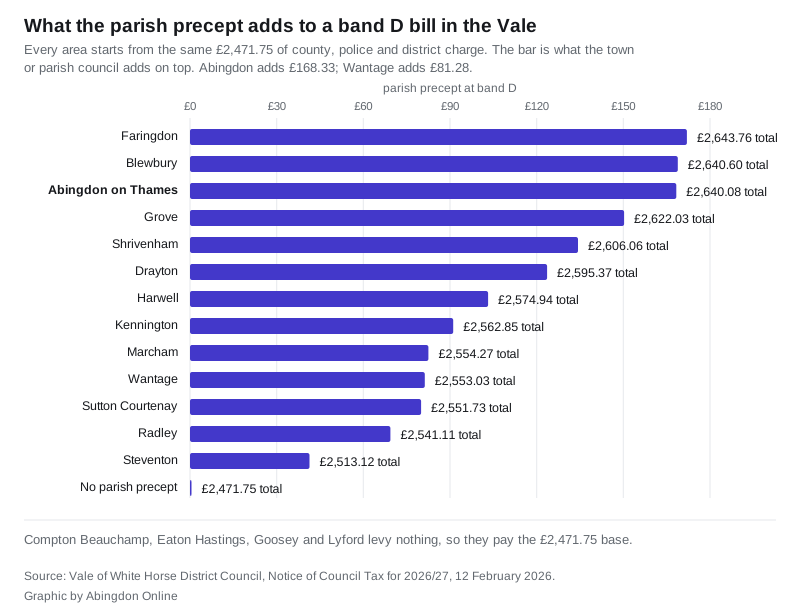
| Area | Band D 2026/27 |
|---|---|
| Faringdon | £2,643.76 |
| Blewbury | £2,640.60 |
| Abingdon on Thames | £2,640.08 |
| Grove | £2,622.03 |
| Shrivenham | £2,606.06 |
| Drayton | £2,595.37 |
| Harwell | £2,574.94 |
| Kennington | £2,562.85 |
| Marcham | £2,554.27 |
| Wantage | £2,553.03 |
| Sutton Courtenay | £2,551.73 |
| Radley | £2,541.11 |
| Steventon | £2,513.12 |
| No parish precept | £2,471.75 |
Wantage pays £87.05 a year less than Abingdon at band D, on an identical county, police and district bill. The entire difference is the town council precept.
How to check your own band, and how to challenge it
Your band is set by the Valuation Office Agency, an arm of HMRC, not by the council. You can look up any address free on gov.uk/council-tax-bands, which also shows you what your neighbours are in.
If you think yours is wrong, the VOA is who you challenge, and it is free. Do not pay a company to do it. Two warnings worth knowing before you start:
- a review can move your band up as well as down
- if the VOA rebands a property, the change can apply to the whole street
The discounts
One adult living alone gets 25 per cent off. The council words this oddly on its own page, explaining that “the residential portion is reduced to 25 per cent”. The effect is the standard single person discount.
A 50 per cent discount applies where nobody living in the home counts for council tax at all. People who are disregarded include:
- full-time students, student nurses and apprentices
- people who are severely mentally impaired
- live-in care workers
- 18-year-olds for whom Child Benefit is still paid, and school leavers under 20
- people in prison or detention
- members of religious communities, and residents of certain hostels
A property occupied only by students is fully exempt, under class N.
If your home has been adapted for a disabled resident, your bill drops to the band below. The council’s reduction for disabilities scheme covers an extra bathroom or kitchen, a room set aside for the disabled person’s needs, or extra space for a wheelchair indoors. A band A home gets a reduction worth a ninth of a band D bill instead. A garage used for a disabled person’s car does not qualify, and the council says so explicitly.
Empty property: there is no free period in the Vale
Worth knowing before you buy somewhere that needs work. The two exemptions that used to cover empty homes were both scrapped here more than a decade ago, and the council states it plainly: class A, for a property that is uninhabitable or undergoing major structural repair, and class C, for an empty and unfurnished property, “both ceased on 1st April 2013”.
So an empty, unfurnished house in Abingdon is charged in full from the day it becomes empty. Exemptions that do still apply include a home left empty by someone who has moved permanently into a care home, one left empty by a person in prison, and one where probate has not yet been granted, which is exempt for six months after the grant.
If you cannot pay
The Vale runs a means-tested Council Tax Reduction Scheme. To qualify you have to be liable for the tax, live in the property, and have less than £16,000 in savings, capital or investments, unless you get the guarantee element of pension credit.
There is no cap on the support. The working-age scheme for 2026/27 sets the maximum reduction at 100 per cent of the bill.
Two practical things about the Vale’s council tax office
Your bill does not come from Abingdon. Council tax administration is contracted to Capita, so correspondence goes to Vale of White Horse District Council, PO Box 882, Erith, DA8 1UN. The phone number is 0345 302 2315 and the email is vowh.counciltax@secure.capita.co.uk. That is a different number and address from the council’s main switchboard.
Tell the council tax team directly if anything changes. The council warns that telling another department, such as the elections team, does not count, because that information “cannot lawfully be shared with us”. Nor does telling the DWP or HMRC. It also warns that failing to report a change within 21 days “is a criminal offence and could lead to prosecution or a financial penalty”.
Also on Abingdon Online
- Abingdon bin collection days: what the district actually does with its 6p
- Parking in Abingdon: every council car park and its tariff
- Abingdon house prices: what homes are selling for now
Have your say